What You Need to Know About SCADA in Alaska
SCADA
Electrical Engineering
Published by Alaska Automation | Electrical, Mechanical & SCADA Engineering
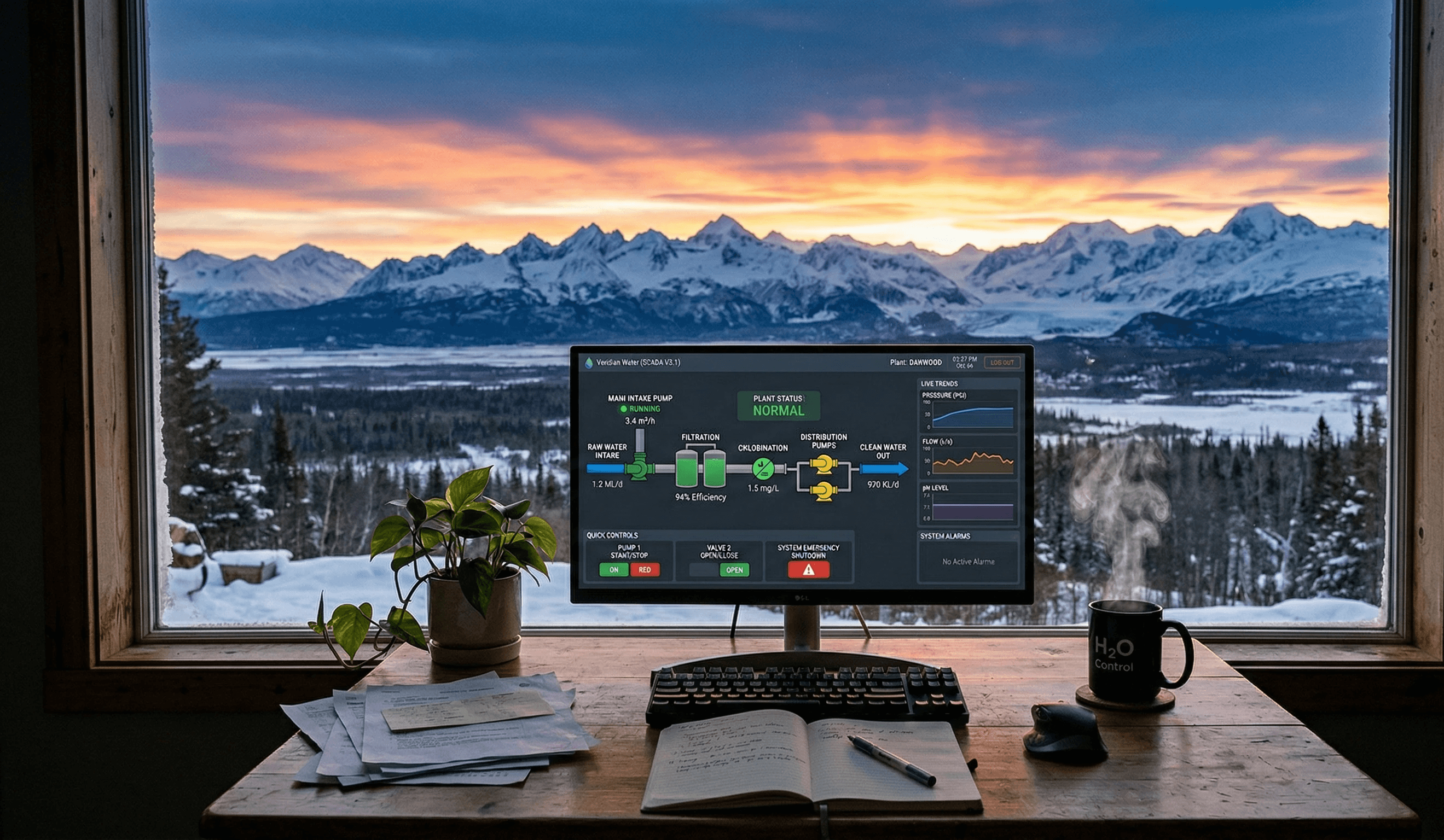
If you operate a water treatment facility, power generation plant, or oil and gas installation in Alaska, chances are your operation depends on a SCADA system — or it should. Supervisory Control and Data Acquisition (SCADA) technology is the backbone of modern critical infrastructure, giving operators real-time visibility into remote equipment, automated control over complex processes, and the data they need to stay ahead of failures before they become crises.
But SCADA in Alaska is not the same as SCADA anywhere else. The geography, the climate, the regulatory environment, and the logistical realities of the far north all shape how these systems need to be designed, implemented, and maintained. This article breaks down what facility operators and project engineers in Alaska need to understand before planning a SCADA upgrade or new installation.
What SCADA Actually Does (and Why It Matters in Alaska)
At its core, a SCADA system connects field instrumentation — sensors, transmitters, flow meters, level sensors, pressure gauges — to a central control platform where operators can monitor and manage their entire process from one location. A well-designed SCADA system:
Provides real-time visibility into process conditions across all monitored points
Triggers automated responses to out-of-range conditions (high pressure alarms, pump failures, tank overflows)
Logs historical data for compliance reporting and trend analysis
Allows remote operation and adjustment without requiring someone to physically be on-site
That last point is especially critical in Alaska. Many facilities — rural water systems, diesel generation plants, pipeline monitoring stations — are staffed intermittently or operated remotely by a single utilities team covering a large geographic area. When something goes wrong at a remote site, the ability to diagnose and respond from a central location is not a luxury. It is a fundamental operational requirement.
Why Alaska Creates Unique SCADA Challenges
Extreme Temperature Ranges
Instrumentation and control hardware that performs reliably in a moderate climate will fail in Alaska if it is not specified for the operating environment. Outdoor enclosures, communications equipment, and instrument transmitters must be rated for extended cold operation — often down to -40°F or colder in interior and northern regions. Heat tracing, insulated enclosures, and low-temperature-rated components are not optional; they are baseline requirements.
Communication Infrastructure Limitations
In the lower 48, SCADA communications typically rely on cellular, fiber, or licensed radio networks with good coverage and low latency. In rural Alaska, many of those options simply do not exist. Satellite communications are often the only viable path, and they introduce latency, bandwidth constraints, and cost considerations that have to be designed around from the start. A SCADA architecture that works perfectly in Anchorage may be completely impractical at a remote hydro facility in Southwest Alaska.
Remoteness and Maintenance Access
When a PLC fails at a facility in Seattle, a technician can be on-site within hours. In Alaska, that same failure at a remote site may mean a multi-day response involving charter aircraft and weather delays. SCADA systems for remote Alaska applications need to be designed with redundancy, remote diagnostics, and failsafe logic that keeps the process operating safely until a technician can get there.
Aging Infrastructure
Much of Alaska's critical infrastructure — particularly in water, electric generation, and oil and gas — was built between the 1970s and 1990s. SCADA systems from that era are running on hardware and software that manufacturers no longer support, with spare parts that are either unavailable or prohibitively expensive. Cybersecurity vulnerabilities on legacy systems are a growing concern, particularly as EPA and NERC tighten cybersecurity requirements.
Key Decisions in Any Alaska SCADA Project
Platform Selection
The SCADA software platform underpins everything else. Ignition by Inductive Automation has become an industry standard for new installations due to its licensing model, browser-based clients, and strong support community. Legacy platforms like Wonderware and iFIX are common in existing installations. Platform migration is a significant undertaking and should not be driven by software preference alone — integration with existing hardware, historian requirements, and long-term vendor support all factor in.
PLC and RTU Hardware
Programmable Logic Controllers (PLCs) and Remote Terminal Units (RTUs) are the field intelligence of a SCADA system. For Alaska applications, hardware selection should prioritize extended temperature ratings, proven reliability in remote deployments, and availability of spare parts. Allen-Bradley, Schweitzer Engineering (SEL), and ABB products are commonly specified for Alaska utility and industrial applications.
Communications Architecture
Before selecting a communications approach, map the entire site topology: what devices need to communicate, how far apart they are, what reliable communications infrastructure exists in the area, and what the consequence of a communications failure is. For many remote Alaska applications, a layered architecture — local wired communications within a facility, point-to-point licensed radio between nearby sites, and satellite for wide-area connectivity — provides the best balance of reliability and cost.
Cybersecurity
The EPA's Water Security Action Plan and NERC CIP standards are increasingly requiring utilities to demonstrate cybersecurity controls on their SCADA systems. Even for facilities not yet subject to mandatory requirements, the risk of a cyberattack on critical infrastructure is real and growing. Network segmentation, access controls, patch management, and incident response planning should be part of every new SCADA design.
When Is It Time to Upgrade?
Consider a SCADA upgrade or replacement if any of the following apply:
Your control system runs on hardware or software that the manufacturer no longer supports
You have experienced unexplained outages or erratic behavior that cannot be traced to field instruments
You are unable to generate the compliance reports required by your regulatory agency
Your operators cannot remotely monitor or control critical process points
You have received a cybersecurity audit finding related to your control system
The cost of a SCADA upgrade is real. But so is the cost of an unplanned outage at a remote Alaska facility — in lost operations, emergency mobilization, and the very real safety implications of losing control of a critical process.
Working with an Engineering Partner Who Understands Alaska
The biggest risk in a SCADA project is not the technology — it is working with an engineering team that does not understand the operational environment. Designs developed without regard for Alaska's climate, logistics, and communications infrastructure create systems that look good on paper but fail in the field.
Alaska Automation provides integrated SCADA and controls engineering for water, electric generation, and oil and gas clients across Alaska, western Canada, and the Pacific Northwest. Our engineers design for the actual conditions your operation faces — not for a data center in a temperate city.
If you are evaluating a SCADA upgrade or new installation, we would welcome a conversation about your project. Contact Alaska Automation to get started.